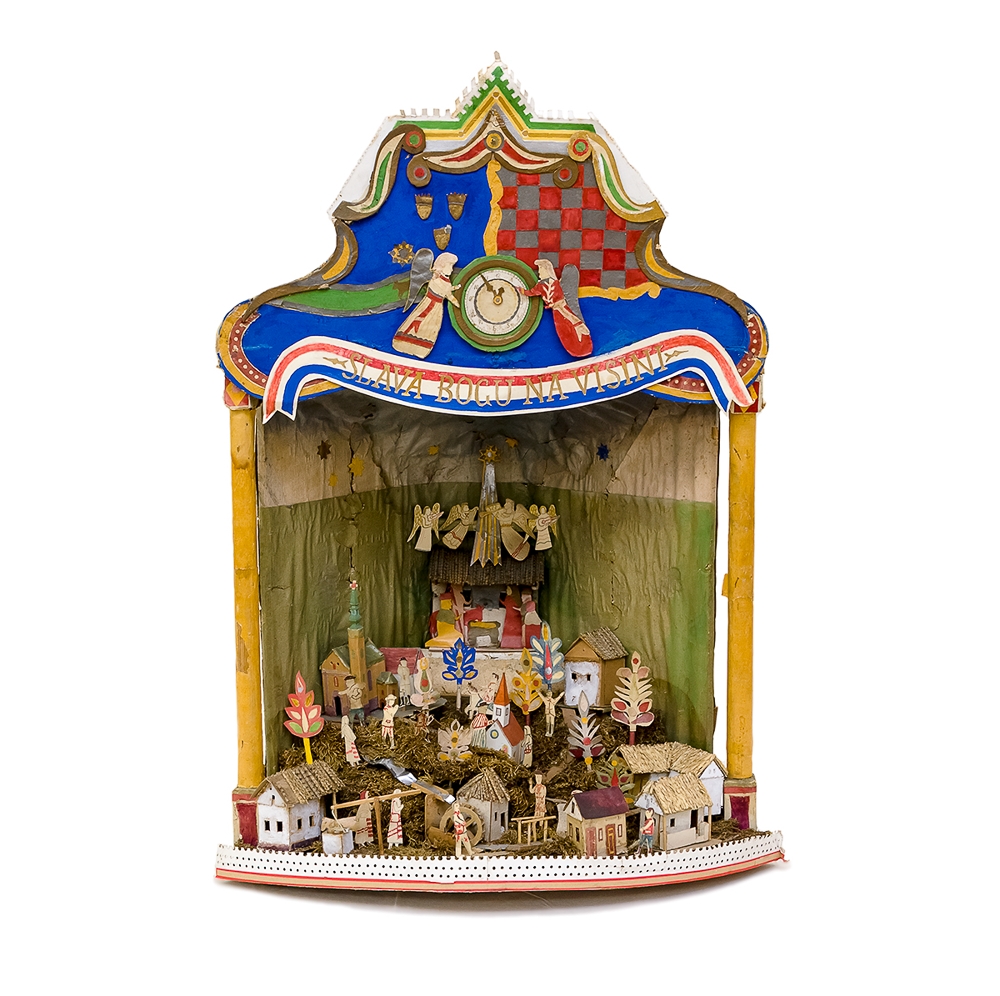
Although nativity scenes were mentioned in the museum's first exhibitions, the Collection of Christmas Nativity Scenes was formed in 2014 by separating it from the Collection of Objects Related to Customs and Beliefs. It contains around 140 nativity scenes with a number of individual parts of the nativity scenes. In addition to objects from the late 19th century and new acquisitions of contemporary authors, a large part of the collection consists of 20th-century nativity scenes from Croatia, Central Europe and Italy. The theme of the nativity scenes, in terms of its content, primarily belongs to the religious and liturgical realm, but with the emergence of various practices it encompasses, it goes beyond that framework and enters the realm of folk customs and public cultural practices. A Christmas nativity scene is a movable figural Christmas decoration, a representation of the events related to the birth of Jesus Christ. It consists of the Holy Family, and a donkey and an ox in a "stable", as well as landscape and ambient scenery, which is where its local names "Bethlehem/Betlem" and "Stable" come from. The presence of other figures varies, mostly are included the figures of shepherds and the Three Wise Men, domestic animals, angels and the Star of Bethlehem, and the inscription "Glory to God in the highest" ("Gloria in excelsis Deo"). Today, Christmas nativity scenes are often set up at the beginning of Advent, but in homes usually on Christmas Eve on December 24, where they remain mainly until Epiphany (January 6) or until Candlemas (February 2). Church nativity scenes are larger in size and generally more complex, and remain set up until Candlemas. As in other European countries, in Croatia nativity scenes were first set up in churches, then in the homes of the wealthiest, appearing in homes of other social classes only in the mid-19th century, mainly in central and northwestern Croatia. At the turn of the century, such family nativity scenes often consisted of paper figures, both purchased and homemade, which were set up in ambient scenery made at home. Although present in the 19th century, mass-produced commercial nativity scenes began to spread in our country in the first half of the 20th century. In addition to nativity scenes in homes and churches, in recent decades they are increasingly being set up in other public spaces as well.
We use cookies to track visits to our pages (Google Analytics) for the purpose of improving the pages. The statistics are collected anonymously, and by accepting, you agree to the use of cookies. Find out more


.jpg)